
Exseed Sat 1 India's first private satellite.
A 1U cubesat, built from scratch in four months, that extended ordinary amateur-radio handhelds across hundreds of kilometres — and proved a private Indian company could put a working spacecraft into a 600 km polar orbit.
What we flew.
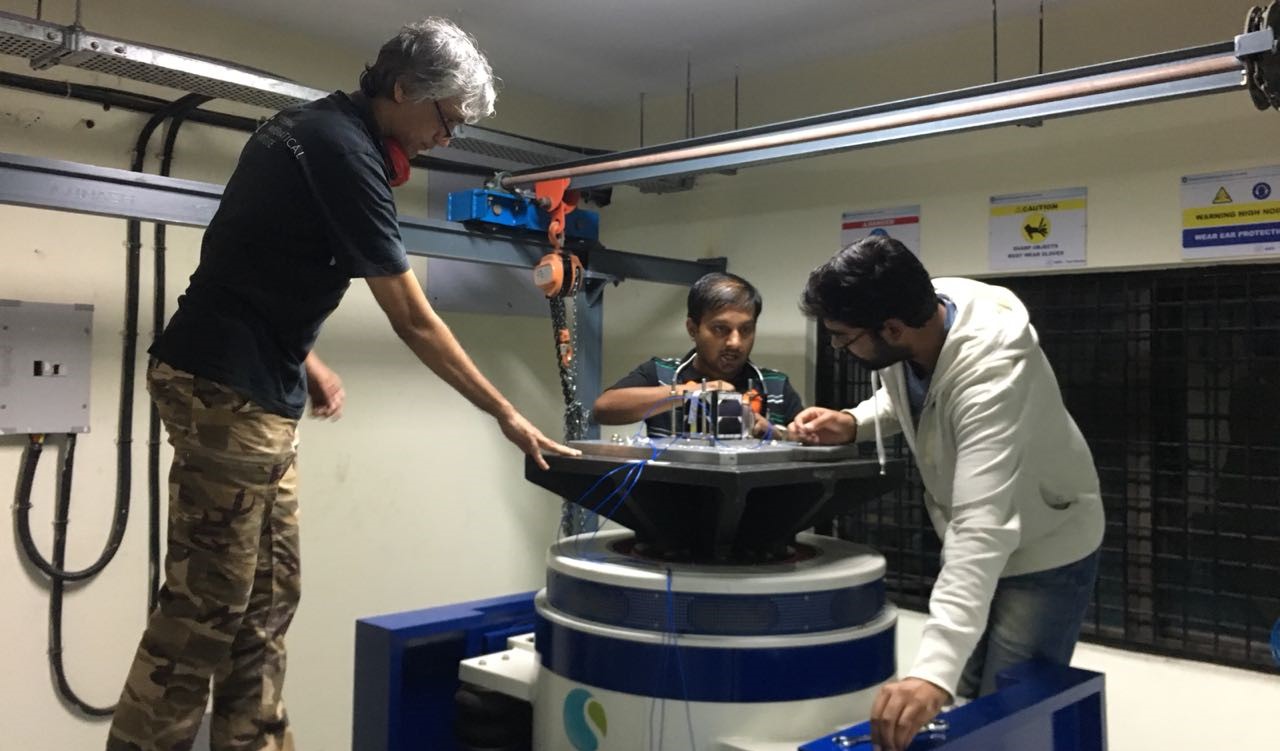
Exseed Sat 1 was built from scratch in four months. Ten years earlier, a satellite of the same complexity would have weighed 100 kg and cost about $100 million. Exseed Sat 1 weighs under a kilogram and cost under $500,000 to build and qualify — the result of a decade of progress in low-power electronics, and a generation of new launch providers competing for ride-share slots.
The mission extends ordinary amateur-radio walkie-talkies across hundreds of kilometres — useful from Everest climbers and offshore sailors to civil-defence and small-boat tracking. It flies at roughly 600 km in a polar orbit, traversing New York to Hyderabad in under an hour at 28,800 km/h.
Onboard, solar panels charge the batteries that keep the radios alive when the spacecraft is in shadow. Temperatures swing from +100 °C in sunlight to −60 °C in the dark; the on-board computer was hardened in software so a stray cosmic ray could not put it in a coma. The radios were developed and tuned with HF Signals in Hyderabad. The pure-silver inductor wires were drawn by Azhar Jawaharat-ul Osman, a traditional jeweller and his karigars in Abids, Hyderabad — better than anything we sourced commercially.
On 3 December 2018, Falcon 9 lifted off from Vandenberg with Exseed Sat 1 riding ride-share alongside AMSAT-NA's Fox-1E. Both deployed simultaneously. The spacecraft began whistling out the letter “V” in Morse code — Beethoven's fifth — followed by RTTY telemetry, every minute, for the rest of its operational life.
The open record.
Verified third-party reading from the open record. Every link checked HTTP 200 at build time.
Satellize — company entry, with the Exseed Sat 1 manifest
India's first private satellite — a small piece of history on Falcon 9
ExseedSat-1: first Indian private satellite
How a Mumbai company put India's first private satellite on Falcon 9
ExseedSat-1 hitches a ride on SpaceX's Falcon 9
SSO-A: SmallSat Express — launch manifest with Exseed Sat 1
Exseed Sat 1 — the original mission page
“A 100-kg, $100-million capability, built in four months for under half a million dollars — by an Indian private company.”